Still Life

LiFang・Daniel Lee・Charlotte Nielsen・Rebecca Bird

March 7-April 18, 2026
Opening Reception Saturday, March 7, 3-6pm

Still life has always been a quiet genre—less a spectacle than a discipline of looking. When the external world refuses to lower its volume, the artist fixes attention on a single interval in time: a piece of fruit, a bouquet on the verge of collapse, a vessel worn thin by touch and years. These seemingly ordinary presences accrue the residue of duration and the sediment of feeling.

In the Dutch Golden Age, Willem Claesz Heda and Pieter Claesz became known for their restrained palettes and lucid compositions. Silverware, glass, and the remains of a meal were arranged with forensic precision, transforming the tabletop into a site of moral inquiry. Light grazed the rims of metal and the lips of goblets, intimating a culture enthralled by abundance and shadowed by vanity.

Nearly contemporaneous, Caravaggio injected a different charge into the genre. His Basket of Fruit dispensed with narrative altogether: no biblical drama, no mythic pretext—only a wicker basket and fruit pressed toward the viewer’s gaze. Stark chiaroscuro isolates the translucent skin of grapes and the taut surface of apples, while refusing to disguise wormholes, bruises, and curling leaves. These imperfections fracture the idealized habit of beauty; ripeness and decay occupy the same instant. Still life, no longer decorative, becomes an unflinching encounter with the real.

The genre has long served as a laboratory for perception, a space in which artists recalibrate the relationships among light, time, and being through the proxy of objects. This exhibition considers how still life is being rewritten today. Five artists from distinct cultural contexts extend the form beyond pictorial representation into spatial and conceptual terrain, working across ceramics, painting, and image-making.

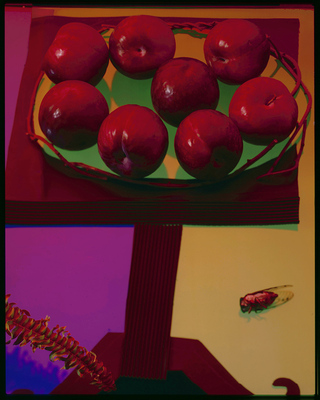
The Taiwanese-born, U.S.-based artist Daniel Lee stages still life as a near-surreal theater. Before digital imaging matured, he mastered the dye-transfer process, exercising granular control over chromatic layering to produce hues at once saturated and finely modulated. Fruit, flowers, fish, and fragments of the human body are collaged into a single frame—lavish, faintly grotesque, suspended between seduction and disquiet. Here, the still life is no longer inert matter but an extension of appetite and corporeal perception. Color operates as a psychological register; a “third hue” emerges as a liminal zone between reality and hallucination.

The Danish ceramicist Charlotte Nielsen draws from ironwork, corroded surfaces, and organic detritus. Muted tonalities and granular textures lend her forms the patina of erosion. Within the smoke and fissures of raku firing, mechanical structures intersect with organic silhouettes, suggesting the relic of a forgotten apparatus. Her still lifes do not rest on tables; they read as crystallization of time itself, holding tension between objecthood and idea.

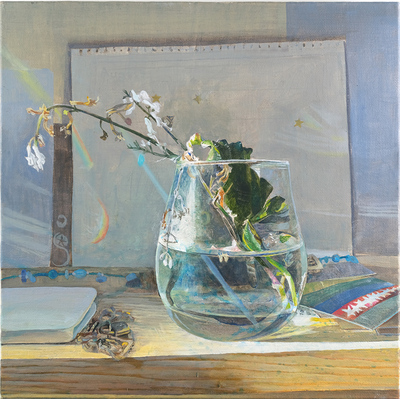
In the paintings of the American artist Rebecca Bird, stillness is edged with unease. Employing a nearly classical vocabulary, she renders intimate, domestic scenes and situates the present within a longer historical arc. Tabletop objects, a window’s oblique light, a figure’s withheld gaze—each becomes a conduit for examining subjectivity and the human condition. For Bird, the studio functions like a camera lens, compressing wide-ranging reading and research into a single scene; as we look at the object, we sense ourselves being looked at in return.

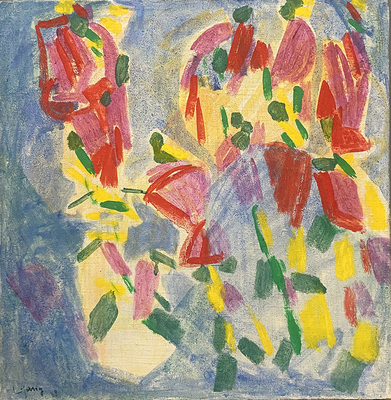
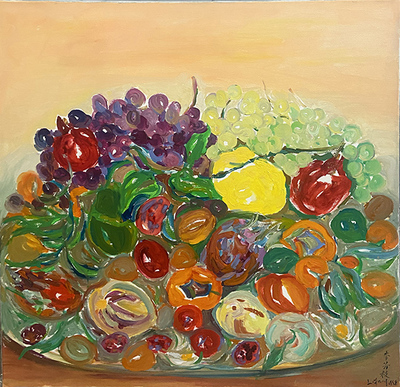
The Taiwanese painter LiFang (Li Fangzhi) (1933–2020) stands as a pivotal figure in postwar art history. A graduate of National Taiwan Normal University and a student of Li Shiqiao, she co-founded the Fifth Moon Group in 1956 with Liu Kuo-sung and others, helping to propel Taiwan’s avant-garde. Decades in Europe positioned her practice between Eastern and Western abstraction. In 2023, her work appeared in the spring exhibition Women Artists and Global Abstraction 1940–70 at Whitechapel Gallery, marking renewed international attention. Her still lifes resist anecdotal detail in favor of equilibrium and cadence. The relational weight of forms and the modulation of color assume primacy, as everyday objects are distilled into structures of composure and quiet resolve.

In an era of image overproduction, still life can seem almost obstinately slow. Yet within that slowness lies its urgency. It teaches us, again, how to look—how objects refract individual experience, and how, in silence, they assemble a deeper emotional order.

Still Life | LiFang・Daniel Lee・Charlotte Nielsen・Rebecca Bird
Date | March 7-April 18, 2026
Opening Reception| Saturday, March 7, 3-6pm
Venue| 5F-4 No.150, Sec. 1, Heping W Rd, Zhongzheng District, Taipei City
Opening hour| Wed-Sat 13:00-19:00 +886 2 23329008

Curator: YIART/沂藝術